
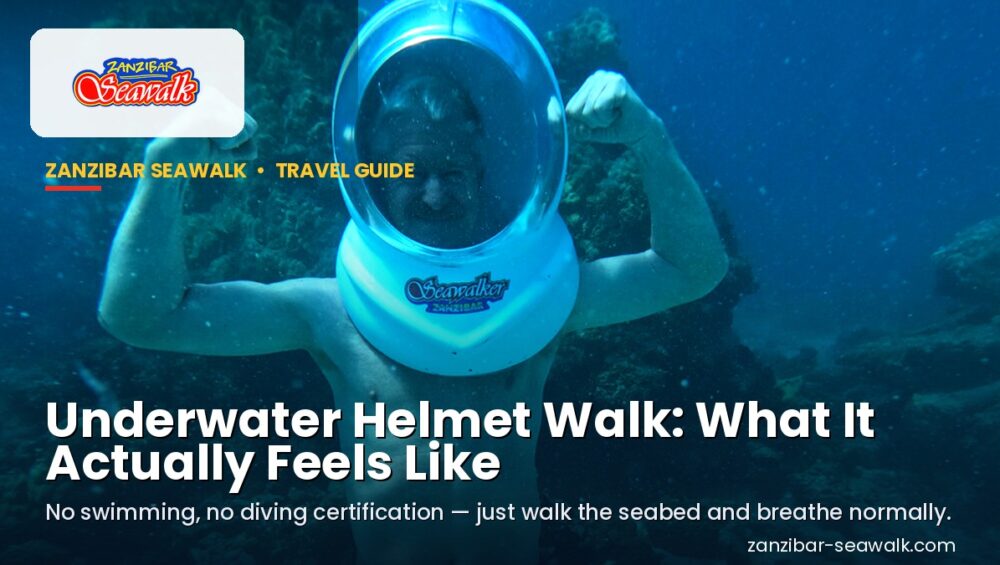
An underwater helmet walk is exactly what it sounds like — you walk along the ocean floor wearing a sealed helmet that pumps in a constant supply of fresh air, so you breathe normally the entire time. No mouthpiece, no tank on your back, no scuba certification. You just walk, look around, and breathe like you would standing on dry land.
I run the SeaWalk operation on Nungwi Beach, and this is the question I get asked most, usually by someone standing at our check-in desk looking a little unsure: “Wait, so I can actually breathe down there? Normally?” Yes. That’s the whole trick of it, and it’s why an underwater helmet walk feels so different from snorkeling or diving.
Let me walk you through what actually happens, step by step, because most of the confusion people have clears up the second they understand the mechanics.
How an Underwater Helmet Walk Actually Works
The helmet is the whole idea. It’s a rigid dome, usually made of fiberglass or metal, that sits over your head and rests on your shoulders — it isn’t strapped to your face like a diving mask. A hose runs from the top of the helmet up to the surface, where a compressor keeps feeding air down into it continuously.
Because the helmet is open at the bottom and heavier than water, the air pressure inside keeps water from creeping up past your chin. Your face stays completely dry the whole time. You can talk, you can wear glasses, and if you’re prone to motion sickness underwater, there’s no mask fogging up or mouthpiece to bite down on.
You don’t swim. You don’t kick. You walk, one foot in front of the other, along a sandy or reef-lined section of seabed, usually somewhere between 3 and 6 metres down depending on the site and the tide. A guide walks right next to you the entire time.
What the First Few Minutes Feel Like
I’ll be honest about this part because most tour descriptions gloss over it: the first thirty seconds are weird. You wade out until the water’s at your shoulders, the helmet goes on, and someone lowers it into place. There’s a rush of air, then a steady hiss as the compressor kicks in. Your ears might need a second to adjust to the pressure — we teach everyone to pinch their nose and blow gently, the same trick you’d use on a plane.
Then you take your first breath, realize it’s completely normal, and the anxiety usually drops within a few steps. I’ve had guests who were nervous about the ocean their whole lives walk out grinning after two minutes. I’ve also had a handful of people tap their guide’s arm and go back up almost immediately — and that’s fine too. Nobody’s forced to finish.
Once you’re settled, the actual walking part is slow and almost meditative. Fish come surprisingly close because the bubbles and noise are minimal compared to scuba gear. You’re not chasing anything — you’re just there, on the seabed, looking at coral and fish at eye level instead of from the surface.
Do You Need to Know How to Swim?
No. This is the single biggest difference between an underwater helmet walk and every other underwater activity, including snorkeling. Because you’re walking on a fixed platform or the seabed itself, not swimming in open water, swimming ability isn’t a factor. Your face never goes underwater, so there’s no risk of accidentally inhaling water either.
The main physical requirement is being able to walk on an uneven, slightly resistant surface (water adds drag) and equalize pressure in your ears, which almost everyone can do with a bit of coaching.
Underwater Helmet Walk vs. Snorkeling vs. Scuba Diving
People ask us to compare these constantly, so here’s the honest breakdown:
Snorkeling happens at the surface. You float face-down, breathe through a tube, and look down at the reef from above. It requires basic swimming comfort and you will get your face wet.
Scuba diving requires certification (or a supervised intro dive), a full tank on your back, a regulator in your mouth, and buoyancy control. You go deeper and cover more ground, but there’s a real learning curve and gear to manage.
An underwater helmet walk sits in between, but honestly it’s its own category. You go shallower than most dives, you don’t need any certification, your face stays dry, and you breathe exactly like you do on land. It trades depth and mobility for accessibility — which is exactly why it works for people who’d never try diving, plus older travelers, people with glasses or contacts, and families with kids who are just a bit too young to dive.
Is It Safe?
Yes, when it’s run properly. A few things matter here, and I’d genuinely tell you to check for these wherever you book, not just with us:
- The compressor supplying air should have a backup system in case of failure.
- Guides should stay within arm’s reach the entire time, not just watch from a distance.
- There should be a clear hand-signal briefing before you go under — how to say “I want to go up,” specifically.
- The helmet should never be strapped or locked to your body. You should be able to simply lift it off and stand up if you need to, since the water is shallow enough to stand in.
Weather matters too. Reputable operators will reschedule or cancel if the sea is too rough or visibility is poor, rather than run the tour regardless. If a company never mentions weather-dependent cancellations, that’s a red flag, not a selling point.
Who Shouldn’t Do an Underwater Helmet Walk
It’s not for everyone, and a good operator will tell you that upfront rather than just take your money. You should skip it, or check with a doctor first, if you have:
- A cold, sinus infection, or anything that makes it hard to equalize ear pressure
- Serious heart or respiratory conditions
- Recent ear surgery
- A pacemaker (compressor equipment can sometimes need to be avoided — always disclose this beforehand)
Most operators, including us, set a minimum age (usually around 8) and sometimes a minimum height, since the helmet needs to sit properly on your shoulders.
What to Bring
You genuinely don’t need much:
- A swimsuit (you’ll get wet up to your shoulders getting the helmet on)
- A change of clothes and a towel for after
- Reef-safe sunscreen — apply it well before you arrive, not right before getting in the water
- Your glasses or contacts, if you wear them — you can keep them on the entire time
- A GoPro or waterproof phone case, if the operator allows guests to bring their own camera
Most tours include professional photos or video of your walk, which is worth asking about before you book, since the underwater visuals are honestly the best souvenir.
How Long Does It Take?
Budget around an hour total, door to door. The actual time underwater is usually 20–25 minutes — that’s about as long as most people want the helmet on anyway, especially first-timers. The rest of the time is the boat ride out, the briefing, and getting geared up.
Where to Try an Underwater Helmet Walk in Zanzibar
Nungwi Beach, on the northern tip of Zanzibar, is where this activity started on the island and it’s still the main hub for it. The water here is calm, shallow, and clear for most of the year, which is exactly the kind of condition an underwater helmet walk needs — you’re not fighting current or fighting for visibility.
If you’re planning a Zanzibar trip and want to add this to your itinerary, book directly with the operator rather than through a generic tour aggregator when you can. It’s usually the same price or cheaper, and you can ask specific questions — about the compressor setup, the guide-to-guest ratio, cancellation policy — that a middleman won’t be able to answer properly.
Frequently Asked Questions
Yes. Since your face stays completely dry inside the helmet, glasses and contact lenses work fine and you can see clearly the whole time.
Typically 3 to 6 metres, shallow enough that a guide can bring you back to standing depth in seconds if needed.
No. It requires no certification, training, or prior experience. A short briefing before you enter the water covers everything you need to know.
Yes, it’s one of the few underwater activities designed specifically so swimming ability doesn’t matter, since you walk rather than swim and your face never submerges.
“Sea trek” and “underwater helmet walk” describe the same type of activity — different operators around the world use different branding, but the equipment and experience are essentially identical.
Ready to try it yourself? Book your underwater helmet walk in Nungwi, Zanzibar and see the reef from the seabed, not the surface.