If you’ve been chasing the next great dive, Europe probably has a spot on your list. And fair enough — the continent punches above its weight underwater. From sunken German warships to ice-cold glacial fissures where you can literally touch two tectonic plates, European diving offers something genuinely rare: history you can swim through.
I’ve spent years exploring dive sites across multiple continents, and Europe’s underwater world consistently surprises even the most well-travelled divers. But here’s something most dive blogs won’t tell you upfront — once you’ve done Europe’s greatest hits, your eyes inevitably drift south. Toward warmer water, wilder marine life, and experiences like diving in Zanzibar that feel completely different from anything the Mediterranean or North Atlantic can offer.
More on that later. First, let’s get honest about where Europe’s diving is genuinely world-class.
Table of Contents
Best Places to Scuba Dive in Europe
And why serious divers eventually head to Zanzibar
European Dive Sites
-
The best places to scuba dive in Europe
1. Silfra Fissure, Iceland — the clearest water on the planet 2. Scapa Flow, Orkney, Scotland — the greatest wreck diving in the North Atlantic 3. Gozo, Malta — Mediterranean diving at its most accessible 4. Medes Islands, Costa Brava, Spain — Mediterranean biodiversity in one place 5. Lofoten Islands, Norway — kelp forests, wrecks, and orca 6. Azores, Portugal — pelagic encounters far out in the Atlantic 7. Croatian Adriatic, Vis Island & Dubrovnik — history underwater
Beyond Europe
The Best Places to Scuba Dive in Europe
1. Silfra Fissure, Iceland — The Clearest Water on the Planet
Nothing quite prepares you for Silfra. Located inside Thingvellir National Park about 40 minutes from Reykjavík, this fissure runs between the North American and Eurasian tectonic plates. The water comes filtered through lava rock for decades before it reaches you, giving visibility that consistently exceeds 100 metres — a number most divers hear and don’t quite believe until they’re looking down a cathedral-like tunnel of blue light with no visible end.
The water sits at a constant 2–4°C year-round, so a dry suit certification isn’t optional — it’s a hard requirement. That said, the dive itself is not technically challenging. It’s calm, slow, and surreal. You float through rock chambers stained with vivid green and yellow algae, through sections called the Hall, the Cathedral, and Lagoon. There’s very little marine life here, which is somehow part of the point. It’s geological wonder in its purest form.
Best time to dive: Year-round, though March to October offers slightly better logistics. Certification required: Advanced Open Water + Dry Suit certification minimum. Good to know: Independent diving is not permitted; book through a licensed operator.
2. Scapa Flow, Orkney, Scotland — The Greatest Wreck Diving in the North Atlantic
Scapa Flow in the Orkney Islands is the kind of place that makes dive historians weak at the knees. In June 1919, the commander of the interned German High Seas Fleet ordered 52 warships scuttled simultaneously — one of the most extraordinary acts of deliberate mass-sinking in naval history. Seven of those battleships and cruisers still lie on the seabed today, along with additional vessels lost during both World Wars.
The water is cold (between 4°C and 14°C depending on season), and visibility ranges from 10 to 20 metres. These are big, complex wrecks with swim-throughs, encrusted superstructures, and marine life that has claimed every surface — seals, lobsters, starfish, wolf fish, and dozens of species thriving inside what are essentially artificial reefs built from 100-year-old steel.
The SMS Markgraf is one of the standouts — a battlecruiser resting upright at 45 metres, still largely intact, her deck guns pointing at nothing. It’s demanding diving, better suited to those with real experience, but the experience is genuinely unlike anything else in Europe.
Best time to dive: May to September for best conditions. Certification required: Advanced Open Water at minimum; some wrecks require technical qualifications. Getting there: Fly to Kirkwall Airport (KOI) on Orkney.
3. Gozo (Malta) — Mediterranean Diving at Its Most Accessible
Malta repeatedly tops European dive rankings, and Gozo, the smaller island to the north, is where the best of it happens. The Blue Hole is the headline act — a natural chimney in the rock that opens into a breathtaking arch and then a wall that drops away into blue nothing. Visibility regularly hits 30 metres, water temperatures stay between 18°C and 26°C depending on season, and the marine life is genuinely excellent: octopuses, parrotfish, moray eels, seahorses, groupers.
What sets Malta apart from most European destinations is how beginner-friendly it is without sacrificing depth. An Open Water certification gets you into most dive sites. The advanced sites — deeper walls, the Um El Faroud wreck, the Inland Sea caverns — give experienced divers plenty to work with. And practically speaking, Malta is easy to reach, affordable by European standards, and has dive operators everywhere.
The MS Zenobia off Cyprus is worth a sidebar mention here — technically not Malta but closely associated in diving itineraries. This Swedish cargo ferry sank on her maiden voyage in 1980 and now lies on her side at 42 metres near Larnaca, complete with a hold full of trucks. It’s considered one of the top wreck dives in the world, not just Europe.
Best time to dive: April to November. Certification required: Open Water for most sites; Advanced for deeper wreck dives.
4. Medes Islands, Costa Brava (Spain) — Mediterranean Biodiversity in One Place
A few hours north of Barcelona, the Costa Brava is an underrated stretch of coastline that serious divers have known about for decades. The Medes Islands sit within a protected marine reserve that has been in place since 1990, and the results are visible the moment you drop below the surface — fish populations here are noticeably denser than almost anywhere else in the Mediterranean.
Fourteen dive sites surround the islands, ranging from shallow reef dives suitable for beginners to deeper walls and caves. You’ll find moray eels that have grown comfortably large because nobody has bothered them in 35+ years, groupers that come curiously close, lobsters tucked under every ledge, and a coral coverage that still impresses even if it can’t match tropical standards.
The nearby Cap de Creus, Formigues Islands, and Tossa de Mar round out a region where you could spend two weeks diving without repeating yourself. Dive operators in the area are plentiful and well-priced compared to the Balearics or Italian coast.
Best time to dive: May to October. Certification required: Open Water for most sites. Planning tip: Book accommodation early for summer; the Costa Brava is popular with local Spanish tourists who know what they’re doing.
5. Lofoten Islands, Norway — Kelp Forests, Wrecks, and Orca
Norway earns its spot on this list through sheer drama. The Lofoten Islands are visually unlike anywhere else in Europe — jagged peaks rising straight from the fjords, fishing villages clinging to rock, and below the waterline, a completely different kind of spectacle. Dense kelp forests filter the light. Old wrecks lie scattered in the fjords. The marine life includes wolf fish, anglerfish, and an unnerving variety of creatures that look like they were designed by someone with a dark sense of humour.
The headliner, though, is what happens between November and January: hundreds of killer whales and humpback whales follow a herring migration into the shallow waters, creating one of the few places on earth where you can enter the water with orca hunting actively around you. Operators use fast RIBs to get divers into position, but be realistic — it’s cold (2°C to 8°C), physically demanding, and the animals are entirely in control of whether they allow contact. But on the right day, it is genuinely one of the most extraordinary things you can do with a set of fins.
Saltstraumen near Bodø is worth mentioning separately — it’s a tidal strait with the strongest maelstrom current on the planet, creating a drift dive experience that has no real equivalent.
Best time to dive: June to September for kelp forest diving; November to January for orca. Certification required: Advanced Open Water; dry suit certification mandatory.
6. Azores, Portugal — Pelagic Encounters Far Out in the Atlantic
The Azores are nine islands sitting in the mid-Atlantic, far enough from the mainland to catch ocean currents that bring deep-water species close to the surface. This is big-animal diving: blue sharks, mako sharks, mobula rays, hammerheads, sperm whales in the right season. The Princess Alice Bank is a submerged seamount in the open ocean where enormous schools of fish gather — it’s the kind of dive that converts reef divers into committed pelagic junkies.
Visibility can reach 40 metres in the right conditions, and the water temperatures hover around 18–22°C in summer, which is warm enough for a 5mm wetsuit if you run warm. This isn’t beginner diving — the best sites are serious open-ocean experiences, and operators rightly require experience and the right qualifications. But the reward is proportional to the investment.
Best time to dive: June to October. Certification required: Advanced Open Water minimum; prior open-ocean experience strongly recommended.
7. Croatian Adriatic (Vis Island, Dubrovnik) — History Underwater
Croatia’s Adriatic coast offers something the other European destinations don’t quite match: warm, clear water (18–25°C, visibility up to 30 metres) with a history underwater that spans from ancient Rome to the Second World War.
Vis Island is the standout for serious divers. The wreck of the USAAF B-17G Flying Fortress lies at 72 metres — too deep for recreational diving but a bucket-list technical dive in genuinely beautiful condition. The surrounding walls, caves, and reef systems give recreational divers plenty to work with at more accessible depths. Near Dubrovnik, the Taranto wreck (an Italian cargo ship covered in marine life) and various cave systems make for excellent daytrip diving without needing to venture far from the old city.
Best time to dive: April to November. Certification required: Open Water for most reef and cave sites; technical certification for the deep wrecks.
What Europe Can’t Give You (And Where to Find It)
Here’s an honest observation from someone who has dived both: European diving is largely excellent despite the conditions, not because of them. Cold water, dry suits, limited visibility — these are often part of the experience, not incidentals to work around. And the history — the wrecks, the archaeology, the geological drama of Silfra — is genuinely irreplaceable.
But for warmth, colour, and sheer variety of tropical marine life, Europe doesn’t compete. The Indo-Pacific reef systems that extend down East Africa’s coastline are in a different category entirely.
Zanzibar sits right in the middle of it. The Indian Ocean off the Tanzanian coast brings warm, clear water, reef systems with hundreds of species, regular encounters with sea turtles, dolphins, and whale sharks, and a diving scene that is significantly less crowded than any of the destinations above. Scuba diving in Zanzibar means reaching sites that would be headline-grabbing in Europe, on a regular Tuesday morning.
Not Ready to Scuba Dive Yet? There’s Another Way In
One thing that often surprises divers researching Zanzibar: not every incredible underwater experience here requires certification, a wetsuit, or even the ability to swim.
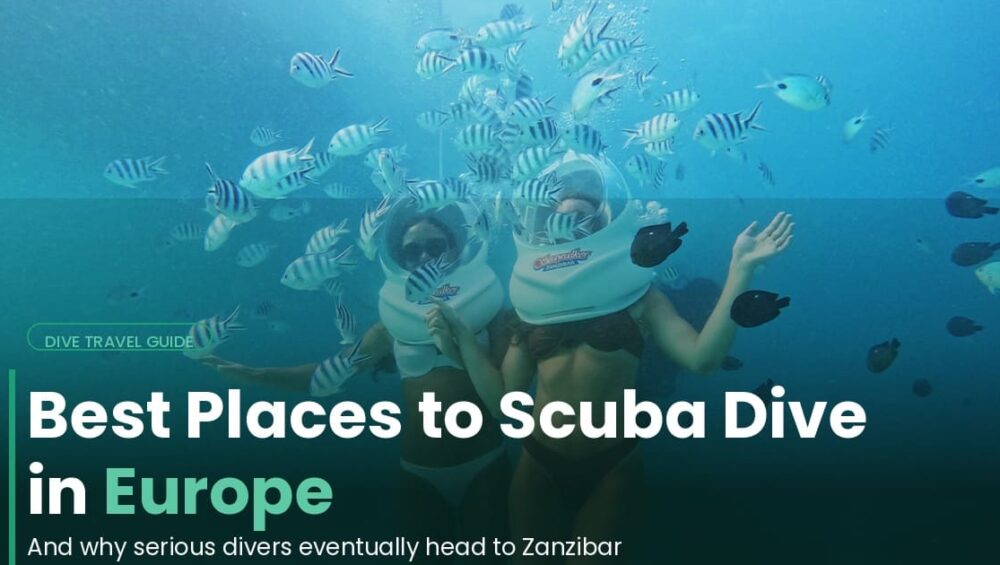
Zanzibar SeaWalk offers East Africa’s first underwater walking tour — a helmet-diving experience at Nungwi Beach where you walk on the ocean floor with a pressurised helmet keeping your head completely dry. No swimming skills needed. Glasses and contact lenses are fine. Children from age 8 and adults with no diving experience at all regularly do this, and the fish are just as real and just as close as they would be through a scuba mask.
It’s not a substitute for a full dive, but as an introduction to what Zanzibar’s underwater world actually looks like — and as an experience in its own right — it’s genuinely memorable. Plenty of experienced divers who visit for a week of reef diving book a SeaWalk on the last day just for the different perspective.
When Should You Actually Go?
For European diving, timing varies significantly by location — Silfra is year-round, Scotland is better in summer, Croatia’s ideal window runs April to November. Each destination has its own logic.
For Zanzibar, the question is simpler. If you want to know the best time to visit Zanzibar Tanzania for diving, the two dry seasons — June to October and December to February — offer the best conditions: calm seas, strong visibility, and the best chance of encountering larger pelagic species. The March to May long rains and the November short rains bring rougher conditions that can limit diving days.
That said, Zanzibar’s dive season is long. Even in the shoulder periods, experienced operators can often get you in the water on the better days.
Putting It Together: A Diver’s Honest Guide
If you’re building a serious dive travel list, Europe belongs on it. Silfra will genuinely change how you think about visibility. Scapa Flow is history you can hold your hand against. Malta’s Blue Hole is accessible enough for newer divers but impressive enough to stay with you for years.
But after you’ve worked through the European circuit — or if you’re looking for your first long-haul dive destination — Zanzibar deserves serious consideration. The marine life is richer, the conditions are warmer, and the overall diving experience is more consistently spectacular.
And if you’re travelling with people who don’t dive, Zanzibar SeaWalk means nobody has to sit it out.
Ready to explore Zanzibar’s underwater world?
Whether you’re thinking about scuba diving in Zanzibar, planning your first underwater walking tour, or just starting to research the best time to visit Zanzibar Tanzania, we’re here to help. Get in touch with the Zanzibar SeaWalk team or book your experience online — sessions fill up quickly during peak season.
Zanzibar SeaWalk is based at Double A Beach Hotel, Nungwi, Zanzibar. We offer East Africa’s first helmet-diving underwater walking experience, with professional guides, no swimming requirement, and instant booking confirmation. Contact us: +255 778 619 627 | info@zanzibar-seawalk.com