
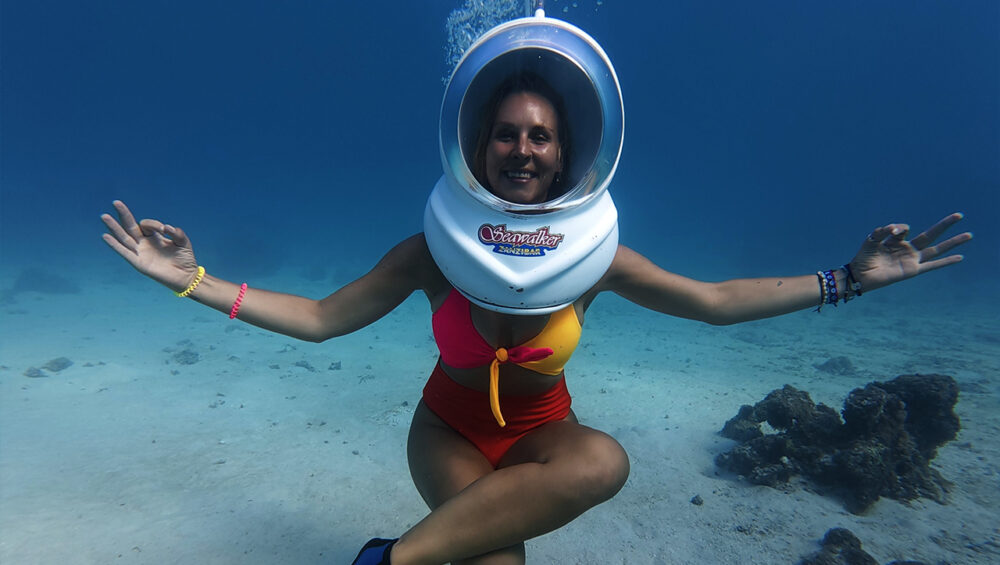
Every week at Nungwi Beach, our guides meet travelers who say the same thing before they even reach the water: “I can’t swim, so I guess I’ll just watch from the boat.” Ten minutes later, they’re standing on the ocean floor, helmet on, staring at a parrotfish three feet from their face. That moment — the surprise on someone’s face when they realize the reef is finally within reach — is why Zanzibar SeaWalk exists.
Scuba diving is an incredible way to see the Indian Ocean’s coral gardens, but it comes with real prerequisites: swimming ability, a certification course, and comfort with breathing through a regulator underwater. For a large share of visitors, those requirements are exactly what keep the reef out of reach. SeaWalk removes them entirely, and that’s the core reason non-swimmers consistently choose it over diving.
The Basic Difference: What Actually Happens Underwater
A SeaWalk tour uses a pressurized helmet that rests on your shoulders, fed by a surface air supply through a hose. Because the helmet is open at the bottom and sealed at the top, air pressure keeps water out while you breathe normally — the same way you would standing in a room. There’s no mouthpiece to bite down on, no regulator to manage, and no need to hold your breath, clear a mask, or control buoyancy. You simply walk down a ladder to the sandy seafloor, usually between 3 and 5 meters, and start walking.
Diving, by contrast, asks you to master buoyancy control, mask clearing, regulator breathing, and basic underwater signals — skills taught over a multi-day certification course. For someone who has never learned to swim, that course isn’t just inconvenient; it’s often a non-starter, since most certification programs require a swim test before you’re even allowed in the pool sessions.
Reason 1: No Swimming Ability Required, Full Stop
This is the single biggest reason non-swimmers pick SeaWalk. Because the helmet supplies air continuously and your feet stay on solid ground the entire time, there’s no swimming motion involved anywhere in the experience. You’re not treading water, not kicking with fins, and never in a position where swimming ability matters. Children as young as seven and travelers in their seventies do the same walk, at the same pace, with the same equipment.
Reason 2: No Certification, No Classroom Time
Recreational diving certifications typically take two to four days and include pool training, theory sessions, and open-water dives before you’re cleared to explore a real reef. Most travelers on a week-long Zanzibar holiday don’t have four days to spend on a course, especially if they’re also trying to fit in Stone Town, a spice tour, or time on Nungwi’s beaches. SeaWalk needs no prior certification. After a short safety briefing on the boat — how the helmet works, hand signals if you want to surface early — you’re ready to go the same day.
Reason 3: The Fear Factor Is Removed
A lot of non-swimmers aren’t just missing a skill; they’re carrying real anxiety about being submerged and unable to control what happens next. Diving asks you to trust equipment you’re actively managing yourself: your regulator, your mask, your buoyancy vest. With SeaWalk, a guide walks beside you the entire time, the helmet does the breathing work for you, and you can signal to ascend whenever you want. For many first-timers, that difference — from “I am responsible for my own air” to “a professional beside me is handling this” — is what makes the ocean floor feel approachable rather than intimidating.
Reason 4: You Still See the Real Reef
The concern we hear most from skeptical travelers is that SeaWalk must be a watered-down version of the “real” underwater world. It isn’t. You’re walking on the actual seafloor around Nungwi, at eye level with the same tropical fish, coral formations, and sea life that snorkelers and divers photograph. Visibility on a good day can stretch well past 15 meters, and the shallow depth means sunlight still reaches the coral, so colors stay vivid rather than fading to blue-grey the way they can on deeper dives. If you’re curious how this compares to going deeper with a tank, our guide to diving in Zanzibar breaks down what each experience actually shows you.
Reason 5: It Fits Into a Half-Day, Not a Multi-Day Itinerary
A full SeaWalk outing — boat ride out, briefing, the walk itself, and the return — takes about an hour, with the actual time on the seafloor running 20 to 30 minutes. That makes it easy to pair with a sunset dhow cruise, a turtle swim, or a spice tour on the same day, something a multi-day diving certification simply doesn’t allow for visitors on a standard beach holiday.
What Our Guides See on the Water
Our team has walked hundreds of non-swimmers through their first — and often only — underwater experience. A pattern shows up almost every time: people arrive tense, unsure whether to trust a helmet they’ve never worn, and within the first two or three minutes on the seafloor, that tension turns into pointing at fish and grinning through the helmet glass. We’ve had grandparents do it alongside grandchildren, honeymooners do it as their one “adventure” activity of the trip, and travelers who’ve avoided the water their whole lives finally get their first close look at a living reef.
None of that happens by accident. Every walk is led by trained guides who stay within arm’s reach throughout, and every helmet and air line goes through a safety check before it touches the water. Trips are rescheduled rather than run when sea conditions aren’t right — not because of strict rules for their own sake, but because that’s what keeps a genuinely beginner-friendly activity beginner-friendly.
When to Go for the Best Underwater Visibility
SeaWalk runs year-round, but sea conditions do shift with Zanzibar’s seasons. If clear water and calm seas matter to you — and they make a real difference in how much of the reef you can actually see — it’s worth timing your trip around the island’s dry months. Our breakdown of the best season to visit Zanzibar covers which months bring the calmest seas and the best visibility, and which to plan around if you’re booking a SeaWalk as part of your trip.
Is SeaWalk Right for You?
If you can’t swim, don’t have time for a certification course, or simply want a lower-pressure way to see Zanzibar’s reefs, SeaWalk was built for exactly that. It’s not a replacement for diving if what you’re after is exploring deeper wrecks or drift dives along a wall reef — for that, certified diving is still the better tool. But for the vast majority of travelers who just want to stand among coral and watch fish swim past at eye level, without a swim test standing between them and the ocean floor, SeaWalk is the more accessible — and often more memorable — choice.