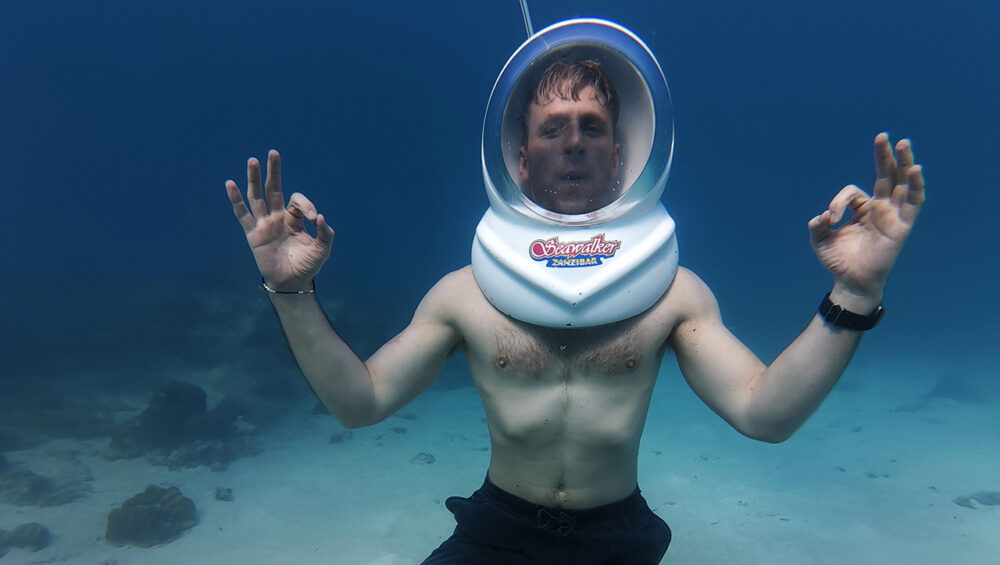
It’s the question almost every first-time guest asks us at the jetty, usually while they’re pulling on the helmet for the first time: “What if I panic down there?”
It’s a fair question. You’re about to walk on the seabed, breathing through a helmet, with the Indian Ocean over your head. Feeling a flicker of nerves before that is completely normal — in fact, our instructors would be more concerned if you felt nothing at all. What matters isn’t whether you feel a moment of panic. It’s what happens next, and that’s exactly what our safety protocol is built around.
We’ve guided thousands of guests through the Zanzibar seawalk experience, from confident divers to guests who have never put their face in a swimming pool. Below, we walk through exactly what panic underwater looks like, why the seawalk helmet system is built differently from scuba gear, and the step-by-step protocol our team follows if a guest starts to feel overwhelmed.
Why Seawalking Is Different From Diving or Snorkeling
Before getting into the “what if,” it helps to understand why seawalking carries a different risk profile than scuba diving in the first place.
With scuba, you’re breathing compressed air from a regulator that requires technique, a mouthpiece bite, and buoyancy control. Panic underwater during a dive is a genuine hazard because a panicked diver may spit out the regulator, hold their breath, or bolt to the surface too fast.
A seawalk uses a full helmet that rests on your shoulders, fed by a continuous surface-supplied air line. You breathe completely normally, the same way you’re breathing right now. There’s no mouthpiece to lose, no mask to flood, and no buoyancy to manage — the helmet’s weight keeps you upright and grounded on the seabed. This single design difference removes most of the mechanisms that turn underwater anxiety into a physical emergency.
That doesn’t mean panic can’t happen. It means the consequences of it are far more manageable, and our protocol is built to handle the emotional side of it, not a breathing crisis.
What Panic Actually Looks Like Underwater
Panic rarely announces itself the way people expect. In our experience guiding guests through the helmet diving experience in Zanzibar, the early signs are almost always subtle:
- A guest suddenly grips the guide rope or a crew member’s arm tighter than needed
- Breathing becomes fast and shallow, visible through the fogging pattern inside the helmet visor
- Rapid head movement, looking up toward the surface repeatedly
- A guest freezes mid-step instead of continuing to walk
- Hand signals become erratic or the guest stops responding to signals altogether
Because every seawalk guide is trained to watch for these cues continuously, not just at the start of the walk, we typically notice the early signs before a guest would even describe themselves as “panicking.”
Our Step-by-Step Safety Protocol
This is the part guests care about most, so here’s exactly what happens.
1. Continuous Visual Contact
Every guest is within arm’s reach of a trained guide at all times during the walk. This isn’t a general lifeguard-style supervision — it’s one-to-one or one-to-two visual contact for the entire duration underwater, specifically so that early stress signals are caught immediately.
2. The Stop Signal
The moment a guide notices distress, they signal the guest to stop walking and stand still. Standing still on the seabed is completely safe indefinitely, since the air supply is continuous from the surface and doesn’t run out the way a tank would.
3. Hand-to-Hand Reassurance
The guide takes the guest’s hand or shoulder and maintains physical contact. This does two things: it gives the guest a tactile anchor, and it lets the guide feel the guest’s breathing rate and movement directly, which is often a better read than visual cues alone.
4. Slow, Guided Ascent
If the guest wants to end the walk, the guide leads a slow ascent up the ladder or guide line at the guest’s own pace. Because the helmet keeps air flowing throughout, there’s no need to rush, hold a breath, or equalize pressure the way divers must — a seawalk ascent has none of the decompression concerns associated with scuba.
5. Surface Support
Topside crew are notified the moment a guide signals a guest is ascending early, so there’s always a second team member ready to assist the moment the guest’s head clears the water.
6. Debrief and Choice
Once back on the platform, our team checks in with the guest, explains what happened in plain language, and lets them decide whether they’d like to try again later in the session or simply enjoy the rest of the day from the boat. There’s no pressure either way.
Why This Protocol Works: The Experience Behind It
This protocol wasn’t written from a manual. It was refined over years of running seawalks with guests of every age, fitness level, and comfort level with the ocean, including first-time swimmers and guests with a genuine fear of deep water. Our lead instructors hold internationally recognized diving and rescue certifications, and every guide completes ongoing in-water rescue drills specifically for the seawalk helmet system, separate from standard scuba rescue training, because the equipment and failure points are different.
We also learned early on that most “panic” moments underwater are resolved by removing uncertainty, not by removing the guest from the water. A guest who understands they can stand still, breathe normally, and be walked back up at their own pace almost always calms down within seconds. That’s the principle behind every step above.
Before You Go Under: What We Do to Prevent Panic in the First Place
Handling panic well matters, but preventing it is better. Every guest goes through a short briefing before entering the water, where guides explain:
- How the helmet and air supply actually work, so there are no surprises
- The simple hand signals used for “I’m okay,” “stop,” and “I want to go up”
- What guests will see and feel in the first thirty seconds underwater, since that’s when most first-time anxiety peaks
You can read more about this preparation on our pre-dive briefing and what to expect page, and see photos and guest accounts on our seawalk experience overview.
Who Should Be Extra Cautious
While the protocol above handles panic safely, we’re upfront that seawalking isn’t the right fit for everyone. Guests with severe claustrophobia, uncontrolled anxiety disorders, or certain cardiac and respiratory conditions should speak with their doctor and with our team before booking. Our staff will always ask about relevant health history during booking and again at check-in, not as a formality, but because it genuinely changes how we plan your group’s walk.
Frequently Asked Questions
Can I actually run out of air if I panic and breathe fast?
No. Air is supplied continuously from the surface compressor, not from a limited tank, so rapid breathing doesn’t reduce your air supply the way it would in scuba diving.
Will the guide force me to keep walking if I’m scared?
No. The guide’s first response to any sign of distress is to stop, not push forward. Continuing only happens if and when the guest is ready.
Is it common for guests to panic?
Genuine panic is uncommon; mild first-minute nervousness is very common and almost always settles once guests realize they can breathe and see normally underwater.
What if I want to stop halfway through the walk?
You can end the walk at any point by using the stop hand signal. Guides are trained to respond immediately and prioritize your comfort over completing the full route.
Ready to Try It Yourself?
Understanding the safety protocol is often what turns hesitation into confidence. If you’d like to experience the reef floor of Zanzibar for yourself, you can check availability and book your seawalk here.