We’ve been operating underwater tours on Nungwi Beach since the day Zanzibar SeaWalk launched East Africa’s first underwater walking experience. Every week, guests ask us the same question before they arrive: “Which Zanzibar excursions are actually worth it?” We’ve watched thousands of visitors come through Nungwi. Some leave buzzing. Some leave disappointed. The difference almost always comes down to how they planned their excursions. This guide is what we tell them.
Let’s start with something most tour sites won’t say out loud: not every Zanzibar excursion lives up to its brochure photo.
The island has exploded in popularity over the last few years. With that growth has come a flood of tour operators, and frankly, some of them are padding numbers rather than delivering experiences. Boats that are older than they look in the photos. “Snorkeling spots” that are so crowded with other vessels you spend half the time dodging fins. Sunset dhow cruises that turn into party boats the moment you push off from shore.
None of that means Zanzibar isn’t extraordinary — because it absolutely is. The coral, the light, the water temperature, the pace of life on this island. It’s genuinely one of the most remarkable places on earth to spend a week. But getting the most out of it requires a little more than clicking “Book Now” on the first result that appears.
So here’s what we’ve learned from being based here on the ground, running excursions in Nungwi week after week, and listening to what guests tell us when they return.
Why Nungwi Is Where Most Zanzibar Excursions Begin
The island of Zanzibar — Unguja, if you’re being precise — stretches about 85 kilometres from tip to tip. Stone Town sits on the western coast, which is where most flights and ferries deposit you. But if you’re planning to actually do things, the north is where you want to be.
Nungwi is the northernmost village, and it sits at a geography that makes it genuinely different from the rest of the island. The tides here are far less extreme than on the east coast, which means the beach is swimmable at almost any hour of the day. The shallow reef shelf around Nungwi and the neighbouring beach of Kendwa creates some of the best snorkelling and diving conditions on the island. And because the northern tip sits at the convergence of the Indian Ocean’s eastern and western channels, the water clarity is remarkable — you get visibility of 20 to 30 metres on a good day.
This is also why most serious Zanzibar excursions either start at Nungwi or pass through it. It’s not just a pretty beach. It’s the operational hub for the island’s best water-based activities.
The Zanzibar Excursions That Actually Deliver
1. Underwater SeaWalk at Nungwi
We’re obviously biased here, but hear us out — because the reason we built Zanzibar SeaWalk is precisely because there was nothing else like it on the island.
Most Zanzibar water excursions require you to know how to swim, to be comfortable with a mask and snorkel, or to have some level of diving certification. That shuts out a lot of people. Families travelling with younger children. Couples where one partner isn’t confident in the water. Solo travellers who’ve never snorkelled before and aren’t going to start in open ocean.
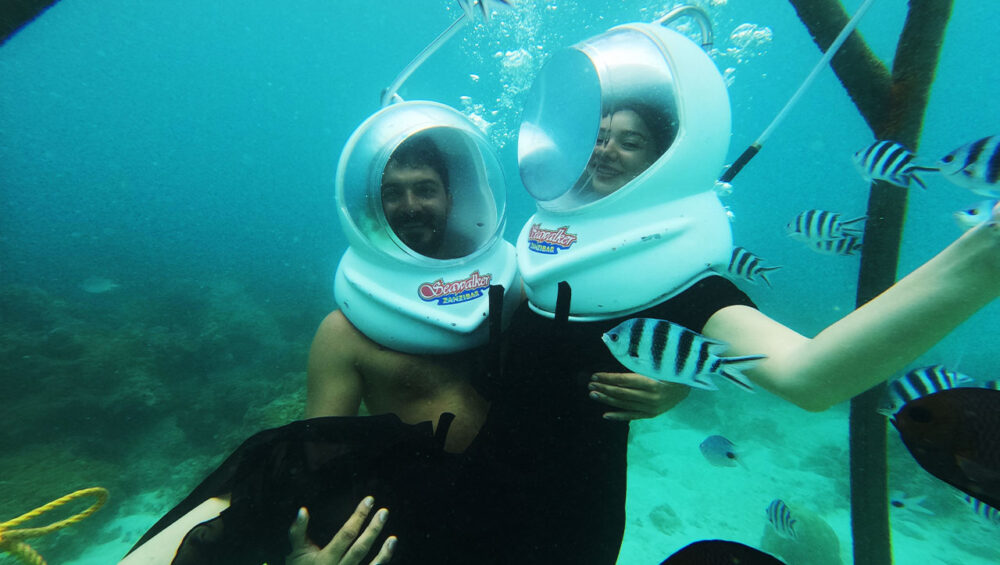
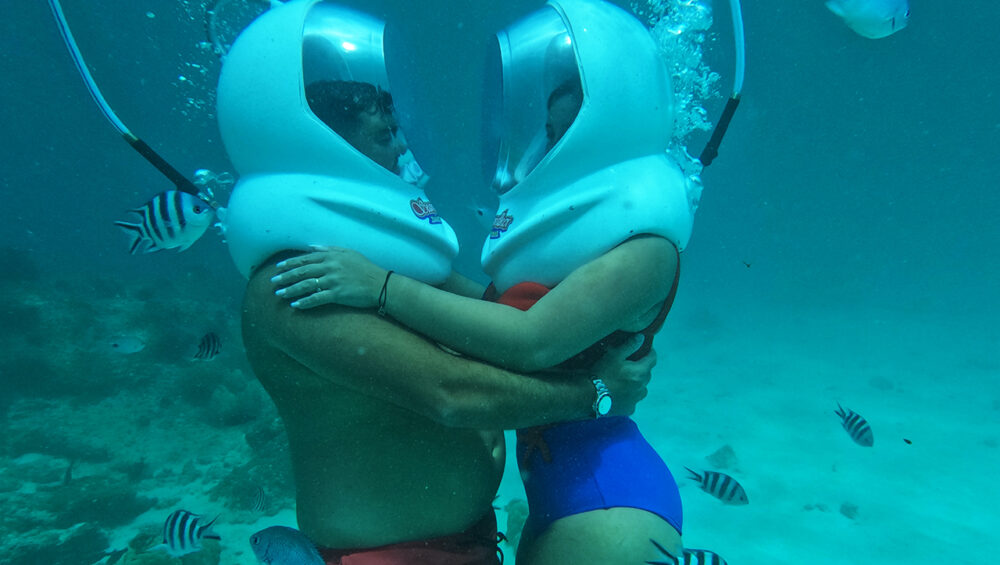
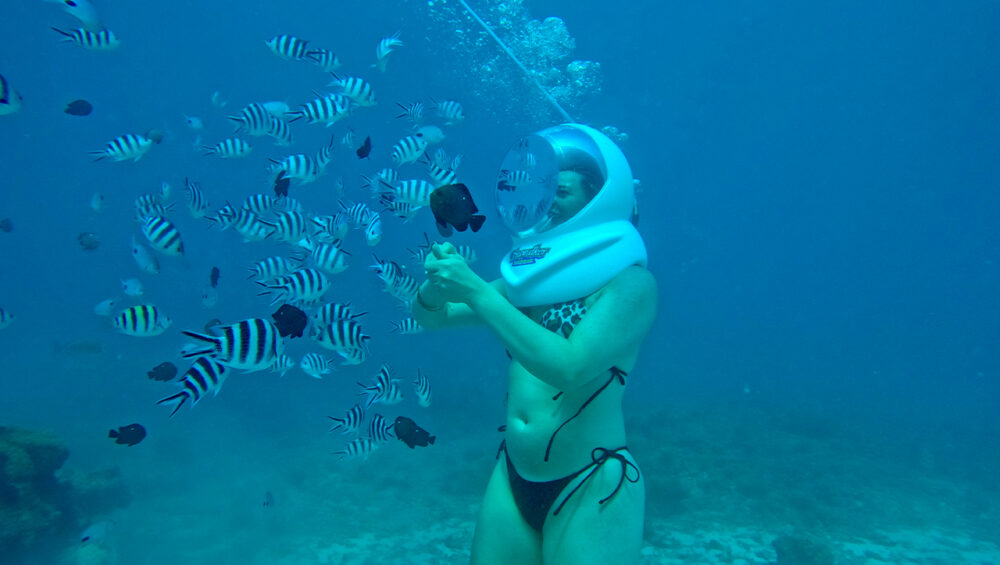
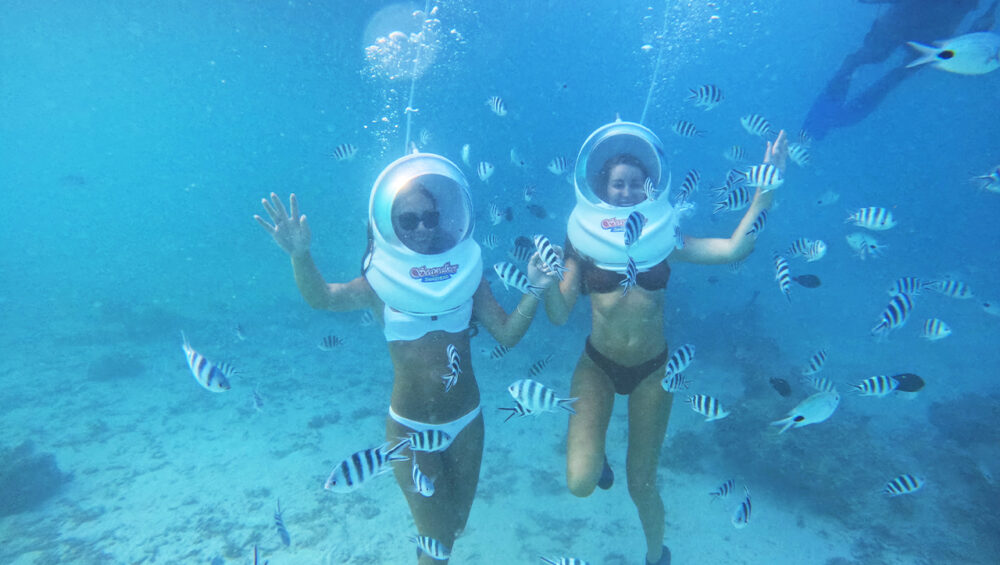
The SeaWalk solves that completely. You wear a specially designed helmet — think of it as a pressurised diving bell for your head — that delivers a steady supply of fresh air from the surface. You walk down a shallow ramp from our boat onto the ocean floor, at a depth of roughly four to five metres. Then you just… walk. Our guides are with you at every step. The fish come to you. The coral is close enough to reach out and almost touch (we ask guests not to, for conservation reasons).
It sounds simple. It feels like nothing else you’ve ever done.
We’ve had guests in their seventies do the SeaWalk. We’ve had children as young as seven. We’ve had guests wearing prescription glasses (yes, they fit under the helmet). We’ve had people who’ve been on five previous Zanzibar excursions come to us on their last morning saying they wished they’d booked this first.
That’s not marketing. That’s just what we hear.
What to know before you book:
- No swimming ability required
- Glasses and contact lenses are fine
- The experience lasts roughly 20–25 minutes underwater
- Our centre is located beside DoubleA Beach Hotel on Nungwi Beach
- Group rates are available for parties of 10 or more
- Book directly at zanzibar-seawalk.com for the best pricing
2. Snorkelling at Mnemba Atoll
Mnemba Island is a private island sitting about three kilometres off the northeast coast of Zanzibar, and the reef system surrounding it is one of the top dive sites in the entire Indian Ocean. You can’t land on the island itself without a stay at the lodge there, but the atoll reef is accessible on excursions from Nungwi.
What makes it special is the fish density. The atoll is a protected marine reserve, which means the reef hasn’t been as disturbed as reefs in more trafficked areas. Hawksbill turtles are common — not rare sightings, but genuine regulars. Bottlenose and spinner dolphins pass through with some frequency. The coral formations, particularly at the northern end of the atoll, include formations that have taken centuries to build.
The honest caveat: book with a reputable operator and ask specifically which part of the atoll they visit. Some cheaper day trips stop at the edge of the reef where conditions are fine but unremarkable. The better trips get you out to the deeper formations.
Best for: Snorkellers and divers comfortable in open water. Children who are strong swimmers. Anyone on their second or third Zanzibar visit who wants to go deeper.
3. Sunset Dhow Cruise from Nungwi or Kendwa
A dhow is a traditional Swahili sailing vessel — low, wide, wooden, and built according to designs that have remained largely unchanged for several hundred years. Watching them tack against the evening wind off Nungwi is one of those images that simply looks like Zanzibar.
A sunset cruise on a dhow is one of the most booked Zanzibar excursions Nungwi offers, and when it’s done right, it genuinely earns its reputation. The light here in the last hour before sunset goes golden in a way that’s hard to describe and easy to photograph. On a calm evening, you’re drifting in warm Indian Ocean water, watching the fishing village fade into the distance.
The caveat worth repeating: read the reviews carefully before you book. Some operators have shifted these cruises toward loud music and open bars, which is fine if that’s what you want, but it’s not what the experience is supposed to be. Look for operators offering smaller capacity boats — 10 to 15 people at most — and ask whether drinks are included or sold separately (sold separately usually means less of a party atmosphere).
Best for: Couples, honeymooners, anyone who wants a slower, quieter evening experience.
4. Sea Turtle Encounter at Baraka Natural Aquarium
About ten minutes from Nungwi village, you’ll find the Baraka Natural Aquarium — a rescue and rehabilitation centre for sea turtles that have been injured, caught in nets, or brought in as eggs that needed protection. The turtles here are Green and Hawksbill species, and the facility is a legitimate conservation operation, not a tourist trap.
You can enter the shallow lagoon and feed the turtles. Yes, you’re in the water with them. Yes, they will swim directly up to you and take food from your hands if you hold it still enough. It’s one of the quieter Zanzibar excursions in Nungwi, but it tends to produce some of the most emotional reactions — particularly from families with young children.
The staff at Baraka are knowledgeable and happy to explain the conservation context. There’s no flashy infrastructure. The experience is entirely centred on the turtles themselves.
Best for: Families, animal lovers, conservation-minded travellers. Excellent combination with the SeaWalk on the same morning.
5. Stone Town Cultural Walking Tour
Stone Town is Zanzibar City’s old quarter, and it’s a UNESCO World Heritage Site — one of the most intact examples of a Swahili trading port in East Africa, and arguably in the world. If you’re basing yourself in Nungwi, a day trip south to Stone Town is about a 45-minute drive and consistently ranks as one of the most memorable Zanzibar excursions for first-time visitors.
What makes it different from most old towns you might have visited elsewhere is the layers. Arab, Indian, European, and Swahili architectural and cultural influences aren’t separated into tidy districts — they’re stacked on top of each other in the same building, the same street, sometimes the same doorway. The famous carved wooden doors of Stone Town are a perfect example: they combine Indian, Omani, and local Swahili design traditions into something that exists nowhere else on earth.
The Freddie Mercury Museum is here (he was born in Stone Town). The former slave market — now a cathedral — is one of the most sobering historical sites in the region. The night food market at Forodhani Gardens, which runs every evening, is where locals and visitors eat together at long communal tables.
Best for: History and culture enthusiasts. First-time visitors. Anyone who wants to understand what Zanzibar is beyond its beaches.
6. Spice Farm Tour
Zanzibar was once the world’s leading producer of cloves, which is how it earned its other name: The Spice Island. Spice farm tours take you to working plantations in the island’s central highlands, where you can see and smell and taste vanilla pods, cardamom, black pepper, nutmeg, cinnamon, lemongrass, and of course, cloves — often still growing wild along the roadsides.
A good spice tour includes a Swahili lunch cooked over a wood fire using the same spices you’ve been exploring. Some include a demonstration of traditional cooking techniques. The better operators will take you to a farm that’s actually working rather than one set up primarily for tourists — the difference is noticeable immediately in the richness of what you see.
Combine a spice tour with Stone Town in the same day if you’re staying in Nungwi. Both are in or near the island’s central south, so the geography makes sense.
Best for: Foodies, cultural travellers, anyone on their second visit to Zanzibar who’s already done the beach excursions.
7. Quad Biking in Nungwi
For those who want something faster and louder, quad bike tours run regularly from Nungwi and take you through the hinterland behind the beach — palm plantations, local villages, red dirt paths, and occasional sea-view lookout points that you’d never find on a beach towel.
The rides are guided, beginner-friendly, and last between two and four hours depending on which package you book. The quality varies significantly between operators, so ask about the age of the bikes before you commit. Some of the cheaper options run bikes that look like they’ve survived several monsoons. The better ones run newer machines and keep the group size small enough that you’re not eating someone else’s dust for the entire ride.
Best for: Adrenaline seekers, solo travellers, groups of friends.
Planning Your Zanzibar Excursions: What We’d Actually Recommend
If you’re spending four to seven days in or around Nungwi, here’s how we’d structure it based on what we’ve seen guests enjoy most:
Day one or two: Get in the water early. The SeaWalk, a snorkelling trip, or both. The ocean is the reason you’re here — start with it before you’ve had time to feel lazy.
Mid-trip: Sunset dhow cruise. By mid-trip you know the beach, you’re relaxed, and the emotional payoff of that golden-hour sail tends to land harder than it would on your first jet-lagged evening.
Day three or four: Sea turtle encounter at Baraka, combined with a wander through Nungwi village itself. The village — with its dhow-building yard, its fish market, its quieter back streets — is an entirely different world from the resort strip. Walk it slowly.
Day five or six: Stone Town and spice farm. Do this as a full day. Leave Nungwi at 8am and you’ll be back by early evening with enough material to talk about for the rest of the trip.
Final morning: If you haven’t done the SeaWalk yet, this is the booking. We’ve had guests tell us it’s the last thing they did in Zanzibar and the first thing they talk about when they get home.
Where to Stay in Nungwi: Choosing the Right Base for Your Excursions
Most people think about excursions and accommodation as two separate decisions. In Nungwi, they’re actually the same decision — where you stay determines how easily you can access activities, how quickly you can get from your villa to the boat, and crucially, how you feel when you come back from a full morning in the water.
For travellers who want their base to match the quality of the experiences they’re booking, the conversation in Nungwi tends to come back to one name.
Safaya Luxury Villas, Nungwi
If you’ve been researching luxury villas in Zanzibar with any seriousness, you’ve likely come across Safaya already. It’s not the island’s most marketed property, but it has quietly become the most-recommended among repeat visitors and honeymooners who’ve stayed in multiple Nungwi properties and know the difference.
Safaya sits directly on Nungwi Beach — not “close to” or “a short walk from,” but right on it, with sea-facing villas that open onto the Indian Ocean. The property has eleven private villas in total: six with direct sea views and five set within a garden that manages to feel genuinely secluded even in a busy beach village. Each villa is 109 square metres, has its own private pool with a wooden deck, hammock, and pool beds, and is designed with a restraint that makes it feel expensive without being showy about it.
What repeatedly comes up in guest feedback — and this matters when you’re evaluating luxury villas in Zanzibar — is the staff. Specific names come up in reviews: the chef Kailash, the manager Flavian. That kind of personalised attention is exactly what separates a genuinely exceptional stay from one that just has nice furniture.
Safaya is adults only, which is worth knowing upfront. If you’re travelling as a family, it’s not the right fit. But for couples — honeymooners especially — it solves something that a lot of Nungwi’s larger resort hotels don’t: genuine privacy. The scale is intimate enough that you’re never fighting for a sun lounger or navigating a lobby full of tour groups.
From a practical excursion standpoint, the location is excellent. Zanzibar SeaWalk operates just along the beach. Mnemba snorkelling departures, dhow cruises, and turtle sanctuary trips all leave from within easy reach. You can book your morning SeaWalk and be back at your private pool before midday without any logistics in between.
Contact Safaya Luxury Villas: safayaluxuryvillas.com | info@safayaluxuryvillas.com | +255 772 458 783
What to Watch Out For When Booking Zanzibar Excursions
A few practical things that will save you frustration:
Book water-based excursions early in your trip, not at the end. Weather and sea conditions can cause last-minute delays or rescheduling. If you leave your snorkelling trip for day six of seven, you’re one rough-sea morning away from missing it entirely.
“Small group” doesn’t always mean small. Some operators use this term for groups of up to 30 people. Ask for the maximum number of participants before you confirm.
Be cautious with any operator who can’t give you a clear meeting point. Legitimate operations — including ours — will give you a precise address, a phone number, and instructions about what to bring. Vagueness before you book tends to translate into disorganisation on the day.
Read reviews from the past six months, not the headline score. Zanzibar’s tourism industry changes quickly. An operator that was excellent two years ago may have new ownership, new boats, and different standards. Recent reviews tell you more than the aggregate star rating.
Book directly where possible. When you book Zanzibar excursions through large third-party platforms, you’re often paying a 20 to 30 percent commission that goes to the platform, not the operator. For the SeaWalk, booking directly at zanzibar-seawalk.com means we can offer better pricing and you can reach us directly if anything changes.
Practical Information for Zanzibar Excursions from Nungwi
Getting to Nungwi from Stone Town: The drive takes 45–60 minutes by dala-dala (shared minibus) or private taxi. Expect to pay around $20–$30 USD for a private transfer. Most hotels will organise this for you.
Best time of year for excursions: The long dry season runs from June through October and is the most reliable for water visibility and calm seas. December through February is also excellent. March through May is the long rainy season — some excursions are possible but sea conditions are less predictable.
Currency and payments: Most excursion operators accept USD cash or mobile money. Card payments are increasingly available but don’t rely on them entirely. Carry small USD bills — exact change makes everything easier.
What to bring on any water excursion: Reef-safe sunscreen (conventional sunscreen damages coral reefs and is increasingly restricted), a rash vest or light cover-up, a dry bag for your phone, and water. Most operators provide the activity-specific gear.
Why Zanzibar SeaWalk
We operate on Nungwi Beach, beside DoubleA Beach Hotel. We’ve been here since Zanzibar SeaWalk launched the first underwater walking experience in East Africa, and we’ve built everything around one idea: that the ocean should be accessible to everyone, not just trained divers.
Our guides are professionally certified and have deep familiarity with the reef they work on every single day. We conduct thorough safety briefings before every walk. We run tours in small groups so every guest gets personal attention. And we’ve made our booking process as simple as we possibly can — you can confirm your spot in minutes and receive instant confirmation.
If you’re planning Zanzibar excursions and want something that combines genuine underwater experience with complete accessibility, we’d love to have you with us.
Book your SeaWalk experience here →
Frequently Asked Questions About Zanzibar Excursions
Do I need to book Zanzibar excursions in advance? For popular water-based activities, yes — especially in peak season (July–August and December–January). The SeaWalk, Mnemba snorkelling trips, and sunset dhow cruises fill up quickly. Stone Town tours and spice farms have more availability on shorter notice.
Can children join Zanzibar excursions? Most excursions welcome children with age restrictions that vary by activity. For the SeaWalk, we accept children from age 7. The turtle sanctuary at Baraka is excellent for all ages. Mnemba snorkelling is suitable for strong swimmers of about 10 and above.
What happens if the weather is bad on my excursion day? Reputable operators — including Zanzibar SeaWalk — will reschedule rather than run a trip in unsafe conditions. We always communicate cancellations as early as possible and never charge guests for weather-related postponements.
Is Nungwi the best base for Zanzibar excursions? For water activities and marine excursions, yes. Nungwi’s northern position, year-round swimmable beach, and proximity to the Mnemba Atoll make it the strongest base for active visitors. Stone Town suits travellers who prioritise culture and history over beach time.
How much should I budget for Zanzibar excursions? A rough guide: SeaWalk from $40 USD, snorkelling day trips from $50–$80 USD, sunset dhow cruise from $30–$50 USD, Stone Town guided tour from $40–$60 USD, spice farm tour from $25–$40 USD. Build in at least $150–$200 USD in your excursion budget for a meaningful week of activities.
Zanzibar SeaWalk operates beside DoubleA Beach Hotel, Nungwi, Zanzibar. Contact us at info@zanzibar-seawalk.com or +255 778 619 627. Follow us on Instagram and TikTok at @ZNZ.SEAWALK.